Weighing a stationary load is the easy job. It gets interesting when the load moves: a crane, a stacker crane, a gantry. There you do not want to know what is hanging in total, but what stands on each individual wheel — while it is travelling.
The problem is rarely the measurement technology. It is space. There is no height available in the travel unit, and rebuilding the structure is not an option.
Flat means: it fits into the bolted joint
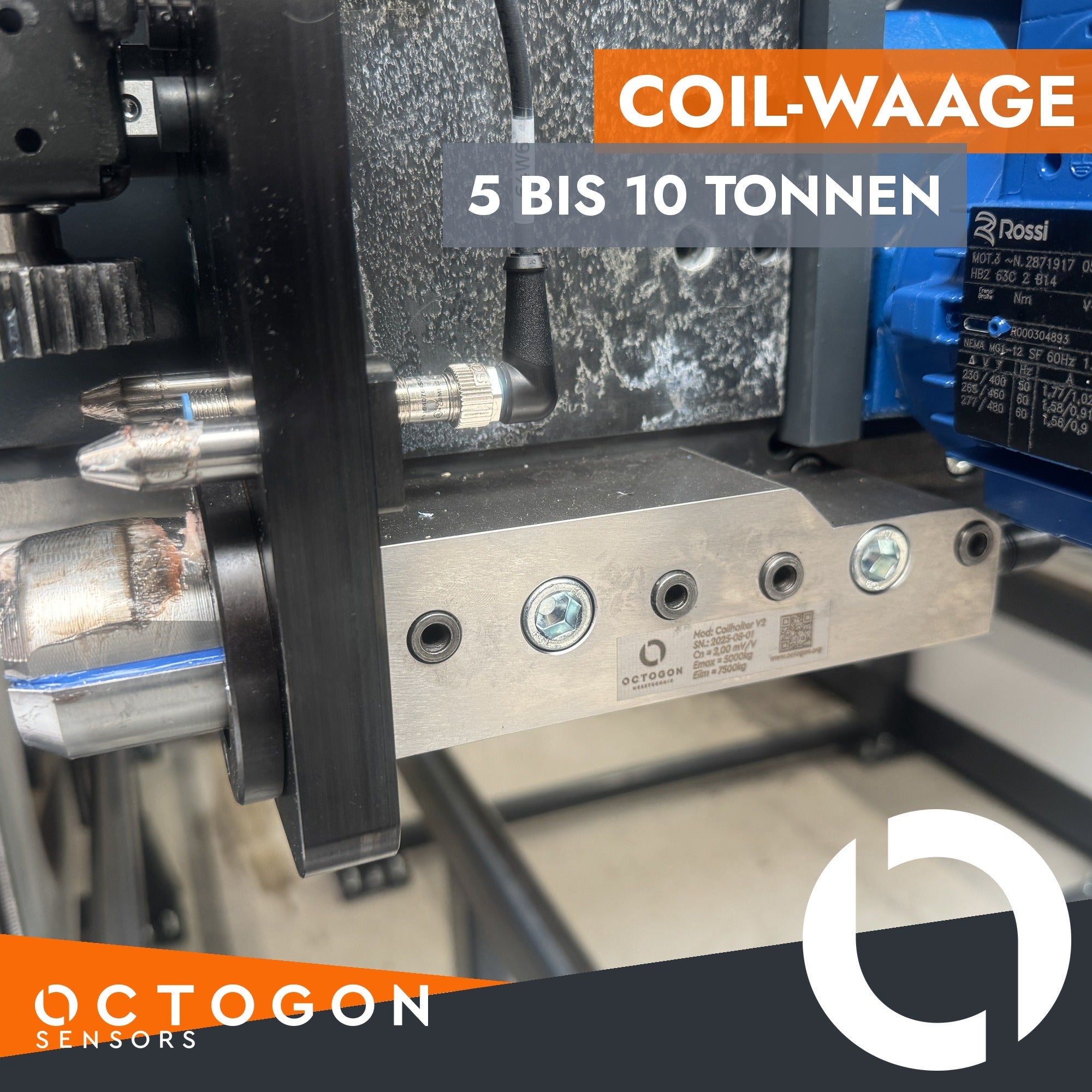
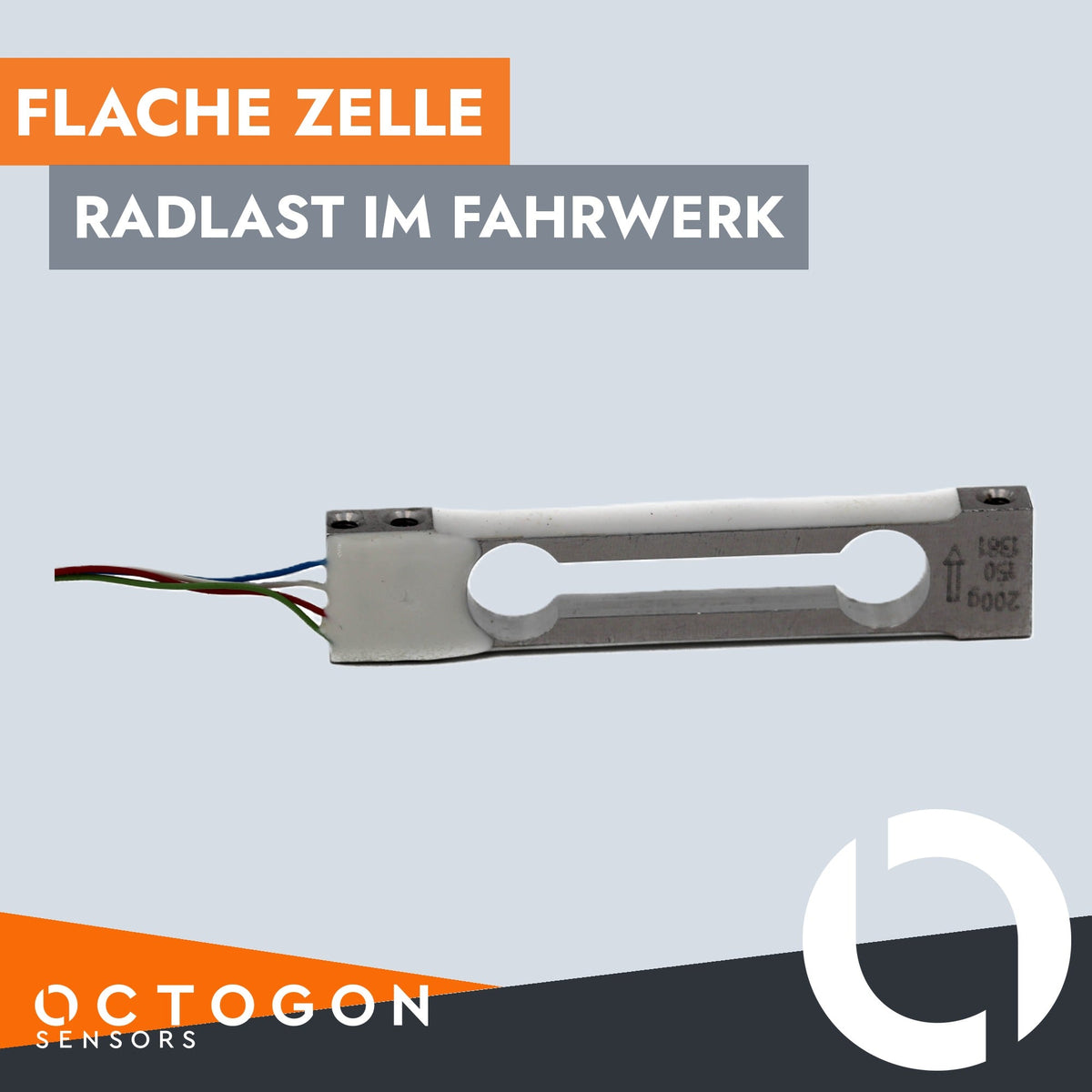
That is why flat load cells exist in plate form. They are not installed in addition but placed inside a joint that already exists — between the travel unit and the wheel block. The force went through there anyway. Now it is measured on the way.

Our LHMA load plate LXH-PRR is built for exactly that, and dimensioned specifically for the DEMAG DRS-M 125 wheel block. Rated capacity 30 kN, i.e. 3,000 kg, in compression. Combined error max. ±0.2 % of full scale, rated output 1 mV/V ±0.1 %. Housing in 17-4PH stainless steel, IP67, connection via M12 connector.

Why the overload figures matter here
With stationary loads, overload figures are a footnote. With moving ones they are the design criterion. A crane travel unit takes impacts: starting, braking, a joint in the rail, a skewed pull. The peak regularly sits well above the rated capacity — and does so for years.
The LXH-PRR is designed for 120 to 150 % safe overload, and its breaking load is above 500 % of the rated capacity. That is why a cell for this application is not simply chosen by rated capacity, but by what passes through it in the worst moment.
What you get to see
Four wheels, four measuring points — and therefore four answers instead of one:
- Wheel load per wheel. Uneven distribution becomes visible instead of averaged away.
- Uneven loading. A stacker crane that loads on one side shows it immediately.
- Overload in service. Not as a calculation, but as a measured peak.
- Load spectrum. Recording over months tells you the actual stress on rail and travel unit.
What flat cannot do
The trade-off should not get lost: ±0.2 % of full scale is good for a plate of this height, but it is not the class of a free-standing cell. A compression transducer with normal height goes considerably further, because it is allowed the spring element the physics needs.
For the question “how is the load distributed across the wheels” that is more than enough. For legal-for-trade weighing it is the wrong sensor — for that there are crane scales designed precisely for it. The honest rule: you choose flat cells because of the installation situation, not because of accuracy.
From signal to display
1 mV/V is an analogue signal and needs amplification — either via a strain gauge amplifier on the DIN rail or via a weighing transmitter. With several wheels it is worth looking at digital interfaces: over CANopen every cell stays individually visible instead of disappearing into a sum.
If the measurement is to become part of a safety case, that is a question of its own — see our page Functional safety SIL | PL.
A different wheel block, a different load?
The plate design is always an adaptation to a specific interface: hole pattern, height, rated capacity. We machine the geometry ourselves, which is why a custom version is the normal case here rather than the exception. An overview of all designs is under load cells & force transducers, the basics are explained in How does a load cell work?.
Send us the wheel block type, the rated capacity and the installation situation at office@octogon.org or through our contact form, phone +43 676 3628453.