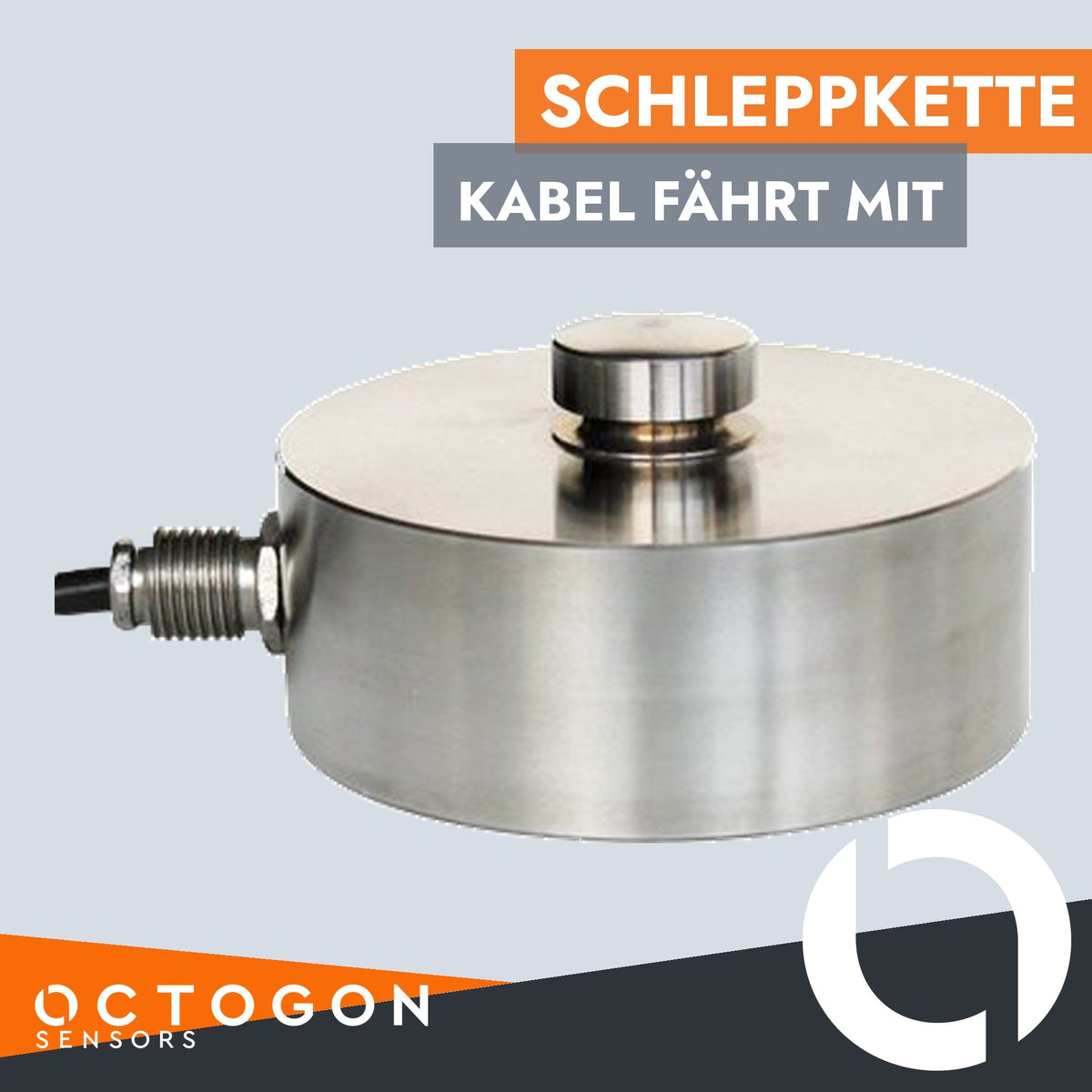
When a load cell travels, its cable travels with it. And that is where most failures in moving applications originate — not at the sensor.
A standard cable is made to be installed. In a drag chain it is instead flexed millions of times. At some point individual strands break inside the sheath without anything being visible from outside. The result is not a clear defect but a reading that jumps or drifts sporadically. Exactly the kind of fault you spend a long time looking for at the wrong end.
The version made for it
Our load cells and force transducers can be supplied with drag-chain-capable cable. It is not a separate product family but an option when ordering — the cell stays the same, only the cable is designed for continuous flexing.
It makes sense wherever the transducer itself does not stand still: gantries and travel units, stacker cranes, handling axes, test rigs with a moving slide.
Three things that help in practice
- A connector instead of a fixed cable. With an M12 connection the cable can be replaced in service without opening or removing the cell.
- Respect the bend radius. The cable's permissible radius is the figure that counts, not the space in the chain. Routed too tightly, even the better cable will not help.
- Strain relief at both ends. The movement must not pull on the connection, and the cable should slide in the chain rather than twist.
Does this fit your application?
Tell us how the cell is moved, what cable length you need and whether a connector is possible. If the environment also brings oil, coolant or temperature into play, that belongs in the selection.
No cable route possible? Then wireless measurement technology is the alternative. How a load cell works in principle is explained in How does a load cell work?; designs for moving loads are shown in Flat load cell for moving loads.
Write to office@octogon.org, call +43 676 3628453 or use our contact form.