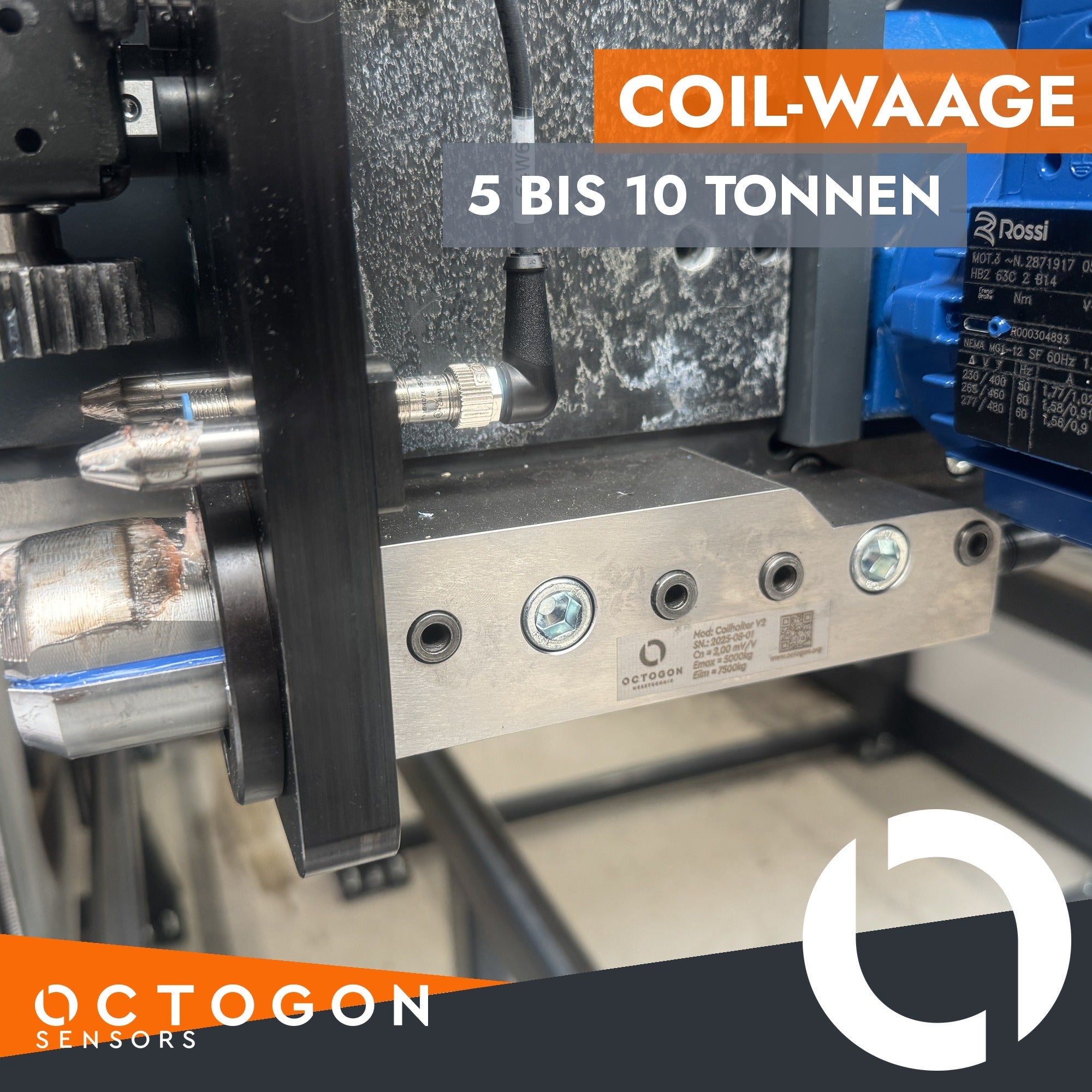
A scale in the material flow always costs two things: space and cycle time. The component has to be set down, weighed and picked up again. With coils weighing several tonnes that is a noticeable intervention in the process. Together with our partner Slinet-ASCO GmbH we solved it differently: the coil holder itself weighs. The load range of the application is 5 to 10 tonnes.
The problem with weighing in the process
A separate weighing station is technically the simplest route. But it is an additional process step, it needs floor space in a usually crowded hall, and it interrupts the flow exactly where throughput matters. On top of that, weighing then happens once, at rest, under ideal conditions. What load actually occurs during transport stays unknown.
The solution: the load-bearing part becomes the sensor
Instead of placing a scale in the sequence, we built the existing coil holder as the sensor. It is a machined carrier that holds the coil and measures the load at the same time. It is connected via an M12 circular connector.
Measurement takes place while the sheet metal is transported to the cutting unit. There is no additional step, no waiting time and no interruption of the material flow. The principle is the same as with weighing modules or with flat load cells placed under a running gear – as described in the article Flat load cell for moving loads. The difference: here a cell is not built into the structure, the structure is the cell. That means geometry and spring body are developed together, see customised force sensors.
What the nameplate says
The nameplate on the component states Mod. Coilhalter V2, serial number 2025-08-01 and three measuring specifications:
- Cn = 2.00 mV/V – the rated output signal. At rated load the sensor delivers 2 mV per volt of excitation. With 10 V excitation that is 20 mV.
- Emax = 5000 kg – the maximum capacity of the weighing range, the value up to which weighing takes place.
- Elim = 7500 kg – the limit load the component withstands without permanent damage. It lies deliberately above Emax, because impacts and off-centre loads occur in service.
Emax applies per holder, while the application range is given as 5 to 10 t. The two fit together because the load is distributed across several supports in operation. How a measuring bridge turns deflection into a signal is explained in the article How does a load cell work?.

What it delivers in operation
The customer names three points: higher process reliability, dependable data for further processing and the detection of real load states during operation. The last point is the most interesting. A weight from the delivery note is a number. A measurement at the holder shows what the coil weighs here and now, and how it rests.
A sensor alone is not enough for that: the signal has to be displayed or handed to the controller, via weighing transmitters or weighing indicators. Further designs can be found under load cells and force sensors. Our thanks to Slinet-ASCO GmbH for the cooperation on this project.
Do you want to weigh in the material flow? Tell us which component already carries the load. Write to office@octogon.org, call +43 676 3628453 or use our contact form.