A vessel needs to be weighed, a mixer, a silo. The obvious answer — build a scale underneath — usually fails because there is no room, and because the plant stands still while the conversion happens.
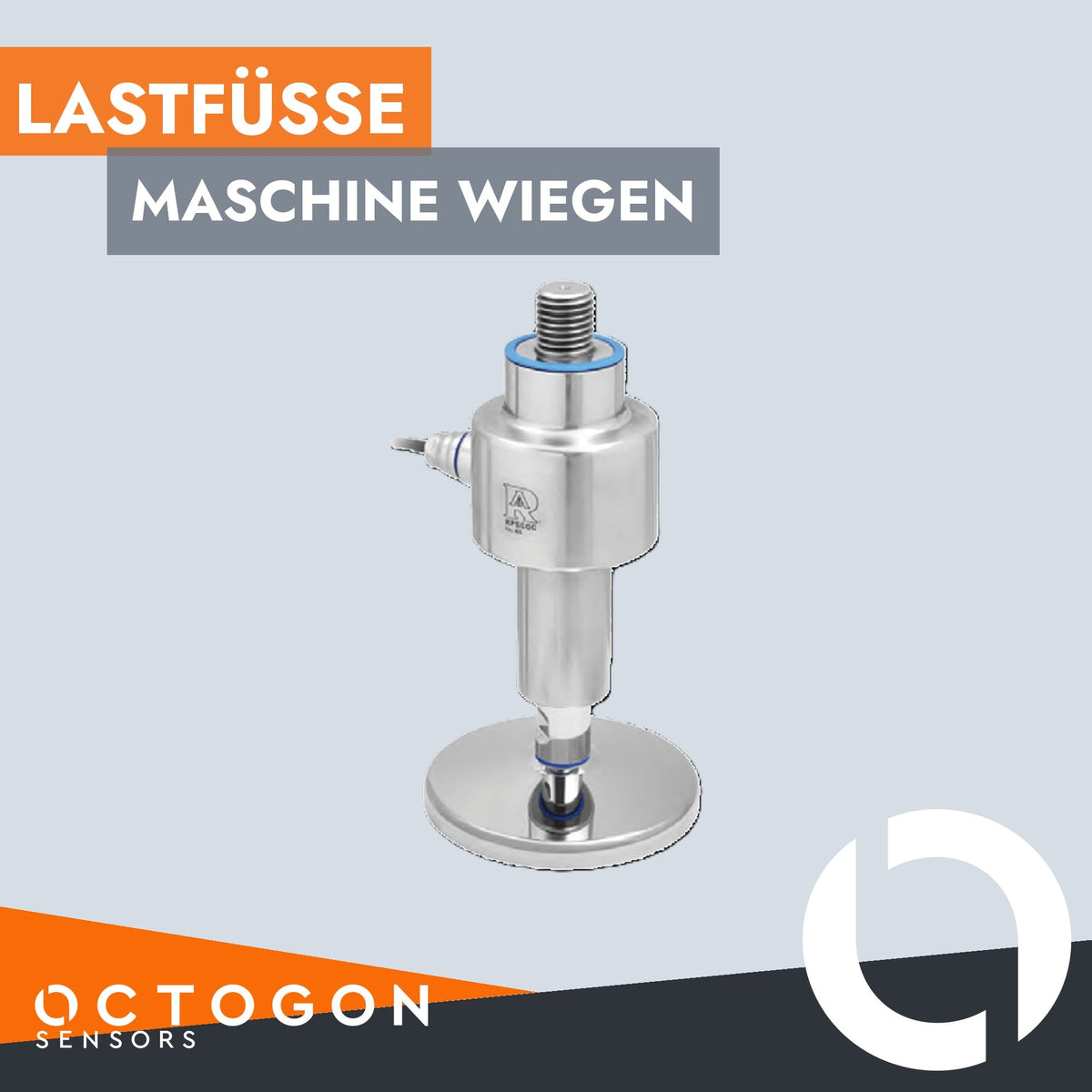
The load foot turns the task around: the load cell is the foot. It carries the machine and measures while doing so. No additional height is added, because the part that was carrying the load anyway now measures as well — and the conversion comes down to swapping four feet.
That opens up applications nobody would have planned as a scale: level via weight instead of sensors inside the vessel, consumption logging on a plant, checking whether a batch is complete. The machine stays what it was and additionally becomes a measuring point.
Two versions, two environments
We offer two weighing feet, and the choice between them has less to do with the load than with what happens around the machine.

The LFLB covers the industrial standard case: 75 kg to 10,000 kg, total error max. 0.07 % FS, IP67, housing in 17-4PH (1.4542). The height adjustment is integrated and offers 10 mm of travel — the detail that saves time in practice, because a foundation is rarely as flat as the drawing. On request with ATEX approval for zone 2–22 and a calibration certificate to ISO 376 or ASTM E74.
The LFLA is intended for plants that are cleaned regularly: 1,000 to 20,000 kg, max. ±0.1 % FS, IP69K, 3-A hygienic design and food-grade cable. IP69K means high-pressure cleaning with hot water — not “splash-proof”.

What actually matters during installation
A load foot only measures the force that genuinely passes through it. Everything diverted alongside — a stiff pipe, a cable harness, a strained frame — is missing from the reading. That is the most common reason for a vessel scale that “does not add up”.
Two things help: actually use the height adjustment so that all feet carry evenly, and decouple lateral forces with a joint. Matching ball joints are available up to 146 kN static load in M6 to M36, adjustable ball-joint feet up to 5,000 kg in M8 to M20.
0.07 % is not the accuracy of your scale
The total error on the data sheet describes the transducer — not the finished installation. In practice, contributions come on top that no data sheet lists: load distribution across the feet, the stiffness of the connections, thermal drift over the day, the resolution of the evaluation.
So a cell rated at 0.07 % FS is no guarantee of 0.07 % at the display. The reverse also holds: a good cell in a clean installation often delivers more than the task requires. If you want to know where your plant really stands, calibrate it as installed — that is part of our on-site measurements.
From the foot to the weight
Several feet deliver several signals. If you only need the total, feed them into a weighing transmitter or a weighing indicator. Often more interesting is the individual view: if you see each foot on its own, you spot uneven loading or a jammed support before the total looks suspicious. Digitally, that works via CANopen or IO-Link.
Which one fits?
Rated capacity is the easy question. The more useful one: is the plant wet-cleaned, does it stand in a hazardous area, and does the result have to be documented? That decides protection class, approval, and whether an ISO 17025 calibration belongs with it.
How a load cell works in principle is explained in our article How does a load cell work?. If no standard version fits, we build the foot as a custom design.
Write to office@octogon.org, call +43 676 3628453 or use our contact form — tell us the load per foot, the number of feet and the cleaning regime, and a concrete recommendation comes back.