


Description
The TCMA is a thermocouple cable sensor, manufacturer type Müller TE-K1.
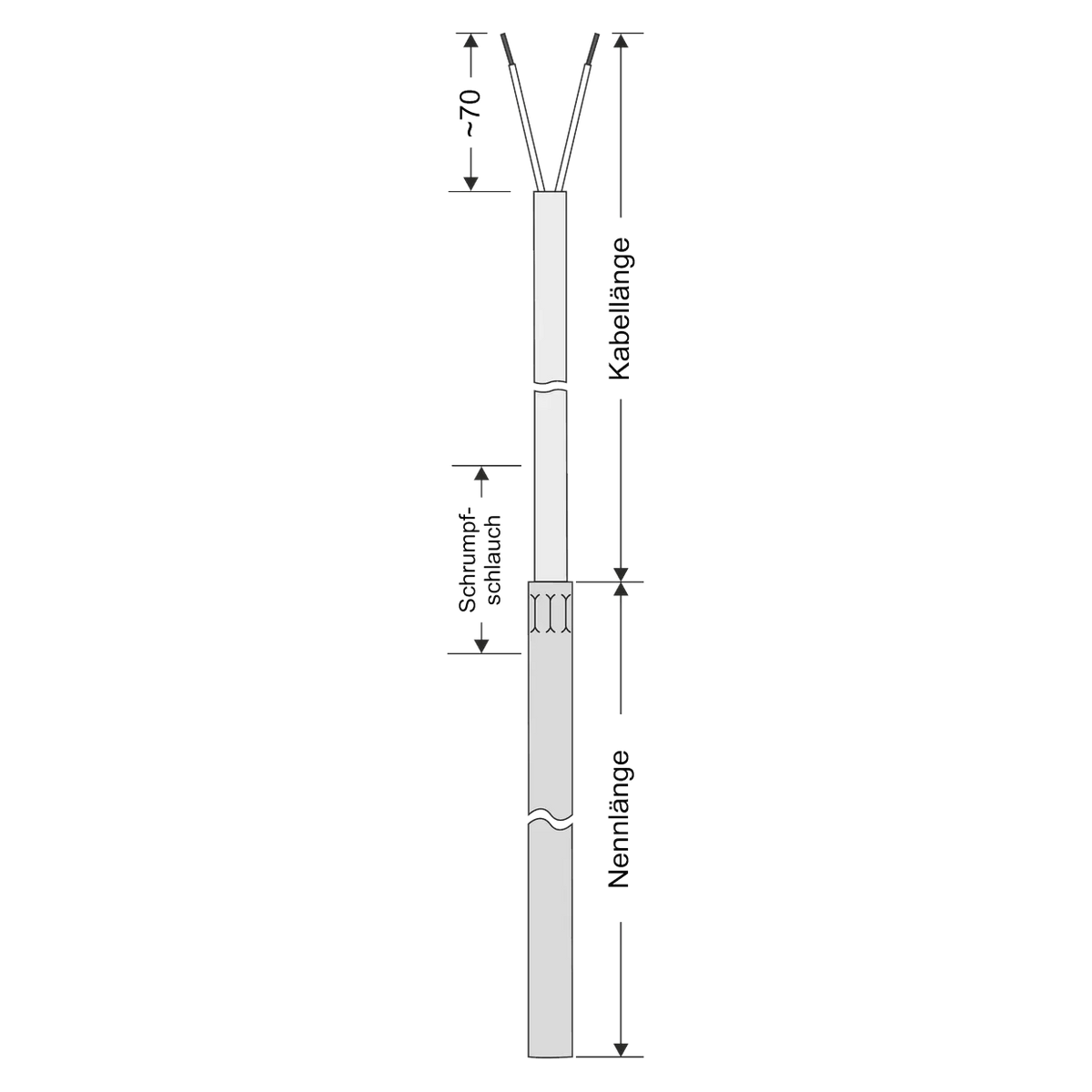
It measures at measuring points where there is no space for a connection head: a rigid protective tube, pressed firmly at the transition, and a fixed cable leading directly to the evaluation. There is no terminal compartment, no electronics and no housing – the sensor is inserted into a bore, a compression fitting or a flange. The protective tube is made of 1.4571 (316Ti) and is approved for up to 600 °C, with Ø 4, 5 or 6 mm and a wall thickness of 0.25 … 1 mm; the nominal length is between 30 and 70 mm, up to 2000 mm on request. The protection class is IP 65 up to 250 °C.
The transition to the cable is made with a hexagonal crimp, with a ring crimp available on request; a shrink sleeve serves as bend protection, optionally a spring. Five cable constructions from PVC to glass silk are available, standard 2 m long. The response time for 6×0.5 mm is t90 30.9 s, and for 6×1 mm is t90 22.1 s.
The measuring element is a thermocouple Type J (Fe-CuNi) or Type K (NiCr-Ni), single or double, without insulating material. The application range for Type J is from -200 … +700 °C and for Type K from -200 … +1000 °C. The limit deviation follows DIN EN 60584-2 Class 1: ±1.5 °C in the range -40 … 375 °C and ±0.004|t| above. The thermoelectric voltage is immediately available at the output, at open ends of 70 mm or at a TE plug; a transmitter is not documented. For insulation, the manufacturer only specifies the test voltage 500 VDC.
Please note before ordering: The application range is determined by the cable, not by the sensor – PVC withstands -5 … +70 °C, silicone -45 … +180 °C, PTFE -75 … +250 °C and glass silk -60 … +550 °C; a Type K up to +1000 °C is useless with a PVC cable. The ambient temperature is not the medium temperature, and for a cable sensor, the cable is in the ambient. IP 65 does not apply to the version with shield braiding. The accuracy table extends further than the application range: Type J is specified up to 750 °C there, but in the application range up to 700 °C. A terminal assignment is not documented – the polarity must be measured before connecting. Weight, system pressure, CE mark and explosion protection are not documented. Both versions bear the product identification KT; they are distinguished solely by the thermocouple type: 0 … 3 is the TE-K1, 4 … 7 is the TE-K1G. The version with GL type approval is the TCMB (TE-K1G).
Advantages at a glance
- Thermocouple Type J or Type K, application range up to +1000 °C
- Limit deviation according to DIN EN 60584-2 Class 1
- Protective tube 1.4571 (316Ti), Ø 4, 5 or 6 mm, up to 600 °C
- Nominal length 30 … 70 mm, up to 2000 mm on request
- Five cable constructions from PVC to glass silk, -5 … +550 °C
- GL version available as TCMB (TE-K1G)