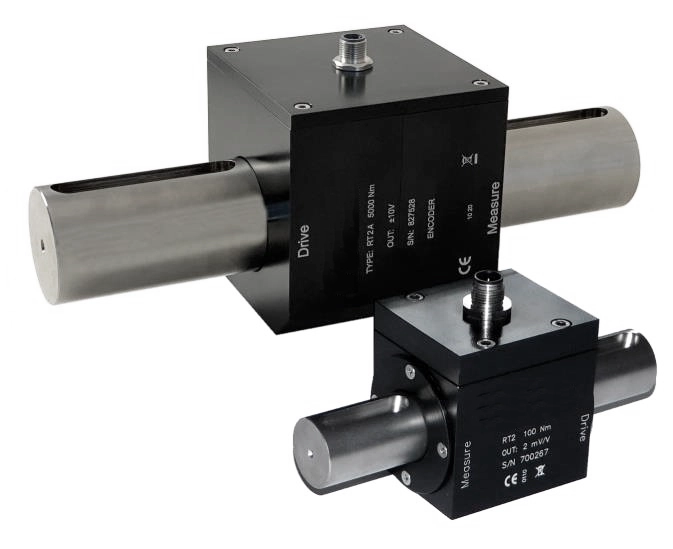
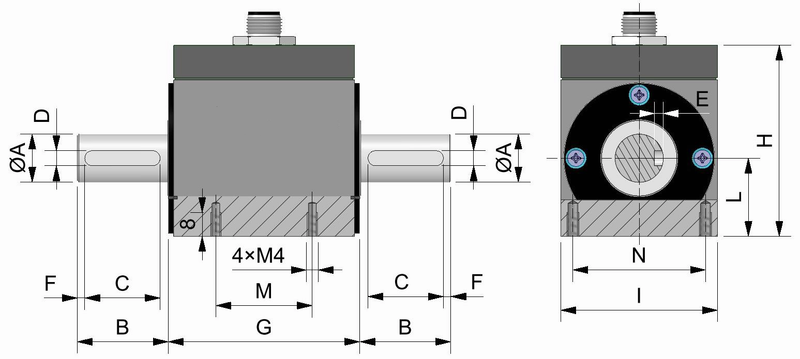
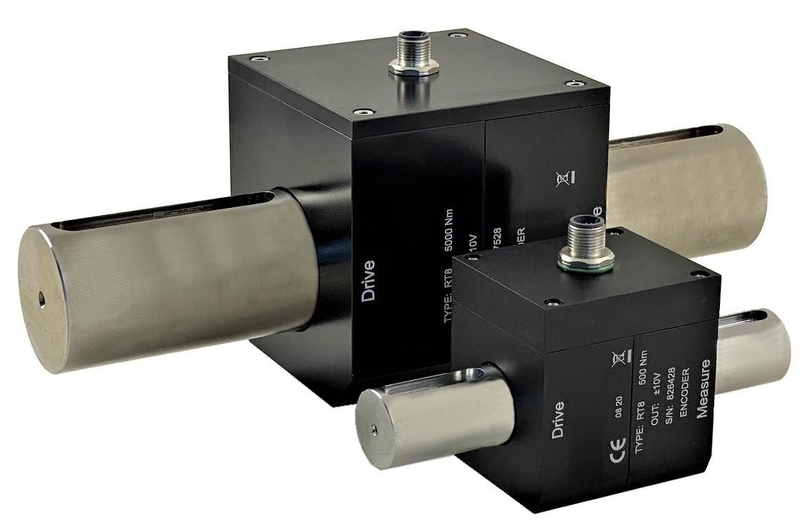
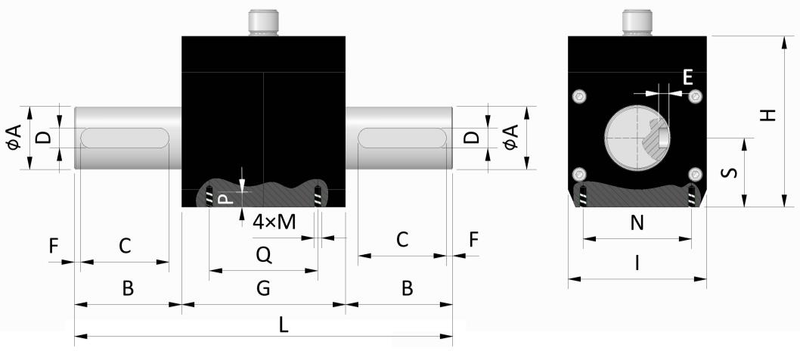
Rotating torque sensors and torque measuring shafts
2 products
Showing 1 - 2 of 2 products
Dynamic rotating torque sensors and torque measurement shafts are installed in the drivetrain and rotate with it. The signal is transmitted from the rotating part via slip rings or contactlessly. This allows you to measure torque during operation, optionally along with rotational speed and angle of rotation.
The core question: how to get the signal off the rotating shaft
The strain gauges are located on the rotating measuring body. Their signal must be transmitted to a stationary part, and there are two ways to do this with significantly different characteristics.
Contact transmission via slip rings. Proven, technically simple, and less expensive to purchase. The transmission is broadband and also suitable for passive versions that output their mV/V signal to an external amplifier. Disadvantages include wear on brushes and rings, limited rotational speed, potential contact noise, and maintenance requirements. For test benches with manageable run times and changing setups, this is often the more economical choice.
Contactless transmission. Energy and signal are transmitted inductively; there is no mechanical contact and therefore no wear. These versions run maintenance-free in continuous operation, tolerate higher speeds, and provide a noise-free signal. Because the electronics rotate with the shaft, they include the measuring amplifier and output a ready-to-use analog signal. The right choice for continuously running systems, high speeds, and serial test benches.
Rotational speed is a design criterion, not a detail
The rated speed limits what you can do with a measurement shaft, and it depends on the bearings, transmission type, and balancing. Common measurement shafts are designed for several thousand revolutions per minute.
Check not only the operating speed but also the run-up, run-down, and potential overspeeds in the event of a failure. Also, pay attention to the balancing quality if you are working near the limit speed: An imbalance in the measurement string puts stress on the bearings, generates vibrations, and overlays the measurement signal.
Couplings and alignment determine measurement quality
A measurement shaft is not a bearing. It must only absorb torsion, and any transverse force, axial force, or bending moment resulting from shaft misalignment will distort the result and damage the transducer. Therefore, the measurement shaft is always installed with two compensating couplings, one on each side.
Bellows couplings are torsionally stiff and transmit torque with almost zero backlash. This is important if you want to measure rapid changes in torque. They compensate for minor offsets but are sensitive to larger ones.
Disk couplings tolerate more offset and higher speeds, but are somewhat more flexible.
Which type is suitable depends on the rated torque and speed; we will coordinate this with you and supply the appropriate couplings. An adjustable mount significantly facilitates alignment during installation, as it allows the measurement shaft to be adjusted to both connecting shafts.
A point that is often overlooked: The measurement shaft changes the torsional stiffness of your drivetrain. In dynamic investigations, this can shift the torsional natural frequency of the setup. If you are investigating vibrations or irregularities, this should be taken into account in the design.
Measure rotational speed and angle of rotation simultaneously
Versions with an integrated encoder additionally provide rotational speed and angle of rotation. This is worthwhile for two reasons.
Mechanical power. Power is derived from torque and angular velocity. You therefore need both for efficiency, engine, and transmission tests, and both variables come from one device at the same time, without synchronization problems between two sensors.
Torque-angle curves. In bolting technology, the final value is not the deciding factor, but rather the profile over the angle of rotation. An integrated angle encoder saves the need for a separate rotary encoder and its coupling.
Rotating torque sensors and torque measurement shafts: choosing the signal output
mV/V passive is the most economical variant and requires an external measuring amplifier. Useful if you already have measurement technology or are recording several channels together.
Analog with integrated amplifier, for example ±10 V, goes directly to a controller or measurement card. No additional device, no coordination.
Digital via USB delivers the value directly to the computer, including software and selectable measurement rate. The most practical variant for laboratories, test fields, and mobile applications.
For fast processes such as starting torques, tooth engagement, or combustion irregularities, pay attention to the measurement rate: It must be able to map the process; otherwise, you will see a smoothed curve instead of the actual peaks.
Typical applications
Engine and transmission test benches, efficiency measurements on drives, pumps and compressors, testing of electric drives and test runs in development, automatic screwdrivers and assembly systems, endurance and lifetime testing, process monitoring on spindles, agitators, and conveyors.
If a measurement shaft does not fit into the string
Sometimes there is not enough installation length, the system cannot be separated, or the stiffness of the string must not be changed. In this case, measurement is carried out on the existing shaft: We apply strain gauges directly to your component and transmit the signal contactlessly via telemetry.
If nothing rotates during operation or if the reaction torque on the housing is to be recorded, static torque sensors are the simpler and cheaper solution.
Calibration and special designs
So that you measure in Newton meters and not in mV/V, we can calibrate the measurement chain according to ISO 17025 in our own laboratory upon request. If no standard design fits, we design and manufacture custom transducers; we supply complete setups via our test bench construction department.
Tell us the rated torque, speed, shaft connection, and available installation length, and our engineers will suggest the appropriate measurement shaft along with the couplings.