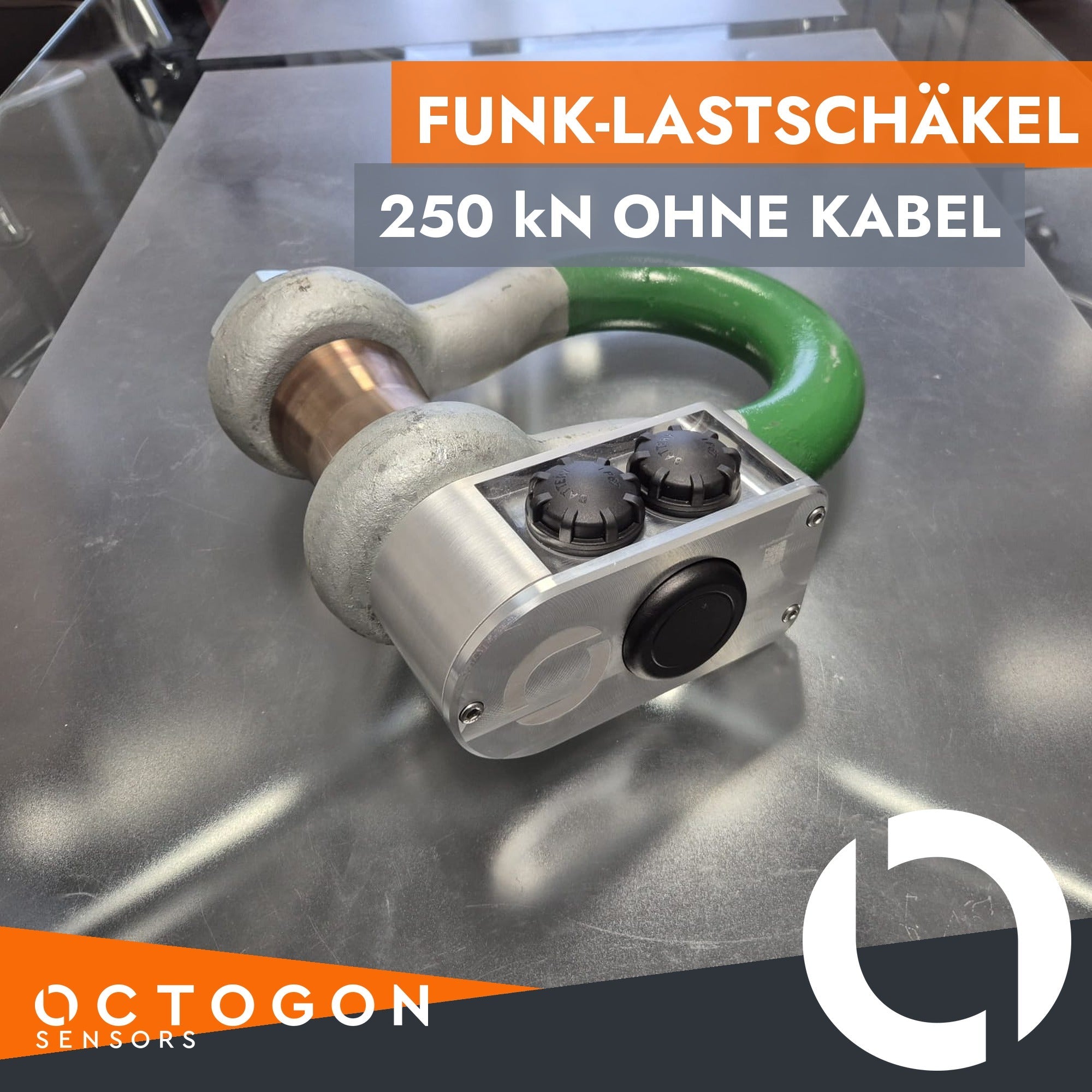
A shackle already sits in the load path. So anyone who wants to know the actual load on a lifting device need not rebuild anything: they replace the existing shackle with one that measures. That is what a wireless load shackle is. We built a version rated at 250 kN. The measuring electronics and battery sit directly on the pin head, and no measuring cable runs to the installation.
Why the shackle is the place to measure
A force can only be recorded where it passes through a component. In lifting and pulling applications that is often the shackle. It connects rope, chain or sling to the anchor point and carries the full load.
The advantage is in the installation. A separate load cell needs space in the assembly and lengthens it. A load shackle takes up the space the shackle occupied before. Nothing else changes. Load pins and measuring axles and tension links follow the same principle: a load-bearing part is swapped for a measuring one.
How the load shackle is built
The kit consists of four parts: shackle body, bronze bushing, measuring pin and nut. The measuring pin is the sensor. It takes up the load and deflects just far enough for that deflection to be measurable, without being damaged. The bronze bushing sits between body and pin and determines where the load enters the pin.
The electronics are housed in an enclosure immediately at the pin head. The battery is integrated there as well. The enclosure carries two battery covers and one operating button. Readings are transmitted wirelessly and in real time to the receiver. The shackle is therefore a self-contained unit: it needs neither a supply nor a signal line.
It is designed for highly dynamic pulling and lifting loads and offers a fivefold safety factor against rated load. The construction is rugged, because parts like these get knocked, caught and dropped in service.

When wireless is the right choice
Wireless is not generally better than a cable. A cable is cheaper, needs no battery and does not stop transmitting because a link drops out. As long as the sensor sits in a fixed position, the cable is the simpler solution. Cables can also be routed along moving axes if you pick the right one – see our article Drag chain rated cable.
Wireless wins as soon as the measuring component itself is moved or hangs free. On a crane hook, in the pull of a winch or at a truss point above a stage, no line can be carried along without chafing, jamming or swinging along. The stated fields of use are woodworking, lifting technology and event and theatre technology. Our article Load pins for theatre technology shows a comparable measuring point with a cable. For weighing at the load, see the designs under crane scale load cells.
What we need from you
Range, sampling rate and battery life depend on the configuration – we clarify that against your application. Tell us the maximum load that occurs, how far apart transmitter and receiver are, how often a reading is needed and whether the data goes into a controller or onto a display unit. Further wireless versions are listed under wireless measurement. Different rated loads and geometries we solve as a customised version.
Write to office@octogon.org, call +43 676 3628453 or use our contact form.